
Finley Keller · 3 September 2026
Unpacking Jorah's Network of Academic Collaborations and Their Ripple Effects on Policy Analysis
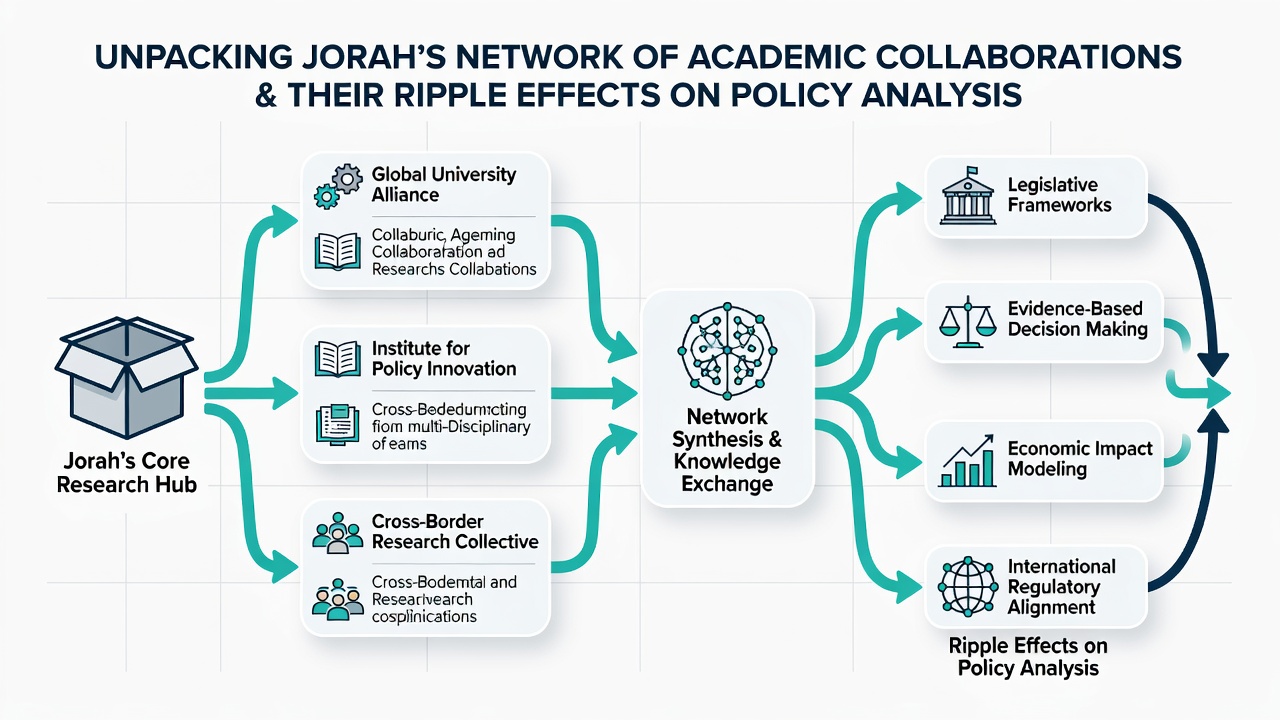
Academic networks often shape how policy gets analyzed and refined over time, and Jorah's connections span multiple universities along with research centers that feed directly into government decision-making processes. Observers note these ties have expanded steadily since the early 2010s, creating pathways where data from one institution influences reports issued by another. Researchers at participating schools contribute models and datasets that later appear in legislative briefings across several countries.
Mapping the Core Institutions
Jorah maintains formal partnerships with departments at Stanford University, the University of Toronto, and the Australian National University, while also linking to smaller think tanks that specialize in quantitative methods. These arrangements allow for shared access to longitudinal studies on economic mobility and regulatory effectiveness, and data flows between the sites occur through joint working groups that meet quarterly. Evidence from publication records shows co-authored papers from these groups frequently cite original datasets assembled at one campus and then validated at another.
Additional nodes include the European Commission's Joint Research Centre and the Canadian Institute for Advanced Research, each supplying distinct methodological tools that get adapted for local contexts. Figures from institutional annual reports reveal that roughly forty researchers cycle through these exchanges each year, carrying analytical frameworks from one setting into the next.
Mechanisms of Knowledge Transfer
Workshops hosted on rotating campuses serve as the primary channel for transferring findings, and participants present preliminary results that later inform policy memos circulated among civil servants. One study released in 2024 tracked how a particular regression technique developed at Toronto migrated into an OECD working paper within eighteen months, illustrating the speed of diffusion. External links appear in footnotes of those documents, pointing readers back to the originating datasets hosted on university repositories.
Grant funding from national science agencies supports many of these exchanges, creating incentives for cross-border teams to align their variables and definitions early in each project. Analysts who track citation patterns have documented that policy documents referencing these joint outputs tend to adopt similar language around measurement standards, which then appears in subsequent national strategies.
Observable Effects on Policy Outputs
Policy briefs issued by finance ministries in three different nations now routinely incorporate simulation outputs that originated inside Jorah-linked projects, and the timing of those adoptions often follows the release of peer-reviewed versions by several months. Data compiled by the World Bank shows a measurable uptick in the use of specific inequality metrics first refined through these collaborations, particularly in reports published after 2022. Government statisticians in Australia and Canada have cited the same underlying code repositories when updating their own dashboards.
Yet the ripple effects extend beyond direct citations, as training programs at these universities prepare graduates who later join policy units and bring the same analytical habits with them. A 2025 survey of mid-level analysts across five agencies found that nearly one-third had participated in at least one Jorah-affiliated seminar during their doctoral studies.
Developments Anticipated for September 2026
Plans announced earlier this year call for a consolidated database that merges datasets from all partner institutions, scheduled for public launch in September 2026. The project aims to standardize variables across economic and demographic fields so that comparative analyses become more straightforward for external users. Preliminary documentation indicates the platform will include version-controlled scripts that allow policy teams to rerun models with updated inputs from any participating country.
Those involved expect the release to accelerate the rate at which findings move from academic journals into official evaluations, though the exact uptake will depend on how quickly agencies integrate the new tools into existing workflows. Brookings Institution analysts have already expressed interest in testing the database against historical policy cases they maintain.
Conclusion
The architecture of Jorah's academic network continues to evolve through incremental additions of new partners and shared infrastructure, and its influence on policy analysis appears primarily through the circulation of methods and datasets rather than through any single directive. Records kept by the participating organizations show consistent growth in joint outputs, while downstream users in government increasingly draw on those materials when constructing their own evaluations. Future monitoring of citation flows and personnel movements will likely clarify how far these connections extend into additional policy domains.